
Pursuit of Perfection
Evolution of Computer Graphics
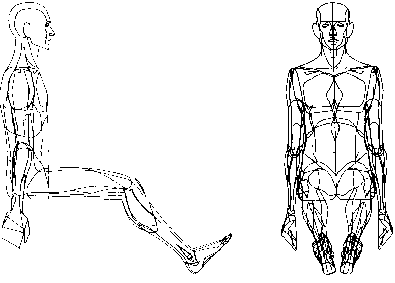
The “Boeing Man” was referred to as the “First Man” by Fetter himself (Carlson).
William Fetter, a graphic designer for Boeing Aircraft Co. is credited for coining the term “Computer Graphics” (or CG), however, he admitted to adopting the term from another Boeing employee, Verne Hudson (Carlson). Working on ergonomic simulations at the time, Fetter created the first known human figure drawn on a computer, the “Boeing Man” (Carlson).
1960
MIT computer programmer Steve Russel leads a team develops the first widespread computer game, Spacewar! (“Computer History”)
1961
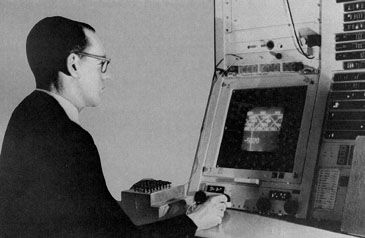
IBM and General Motors teamed up to create the first commercially available Computer Aided Design (CAD) software called DAC-1 (Design Augmented by Computer) (“Computer History”). This led to the invention of the IBM 2250 display terminal and advances in computer timesharing, allowing for more than one terminal to use the same processor (“Computer History”).

Engineers using DAC-1 (“Computer History”).

Ivan Sutherland, while studying at MIT, publishes his dissertation, “Sketchpad: A Man-Machine Graphical Communications System” This is one of the most significant advances in CG and includes features which become the foundation of all future Graphical User Interfaces (GUIs).
With the light pen Sketchpad users were able to draw directly into the software (Sutherland 115). Algorithms in the program assist the user in constraining their drawings to specific geometric design conditions (Sutherland 113). “All of Sketchpad’s displays are generated from straight lines, circle arcs, and single points” (Sutherland 116). The software is able to magnify images as well as incorporate text (Sutherland 116-117). A user could make a master object that allows them to make changes to all instances of that object at once which was very useful for repetitive design work, such as circuit diagrams (Sutherland 117).
He even described how future versions of the software would be able to create drawings in three dimensions (Sutherland 125).
1963
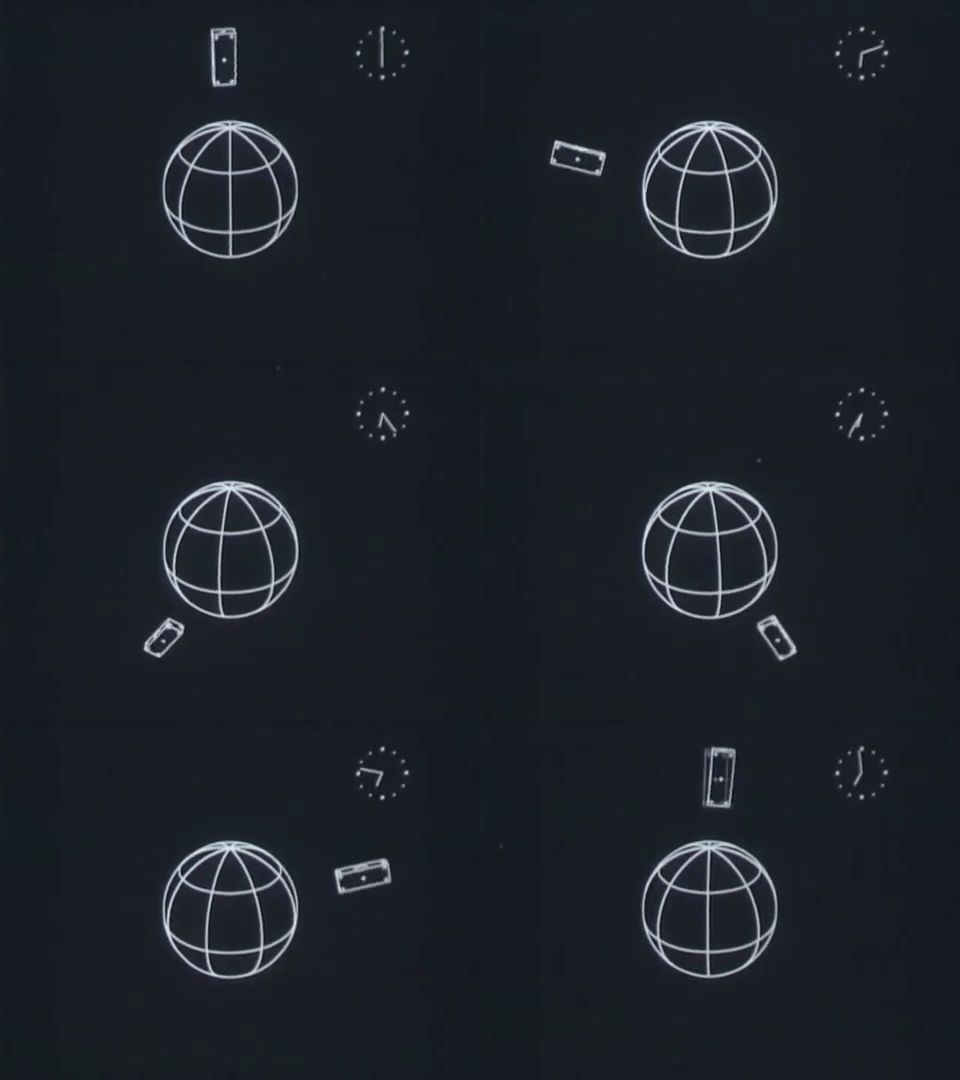
Bell Telephone Laboratories Inc. was a hotbed of computer graphics innovation in the early 1960s (“Computer History”). In 1963, Ken Knowlton developed BEFLIX, a language specifically for computer animation (“Computer History”). Using this language, Ken Knowlton, Stan Vanderbeek, and Lillian Schwartz created software capable to displaying 252 by 184 pixels in 8 shades of gray that could be manipulated to create computer animations. One of the very first computer generated films was also created at Bell by the physicist Edward Zajac (Carlson).
David Evans founds the very first computer science department at the University of Utah (Carlson).
Laurence Roberts writes the first algorithm to hide obscures surfaces (Carlson).
Michael Noll’s Gaussian-Quadratic is the first Computer art displayed in the US (Carlson).
1965

Ivan Sutherland invented the first head mounted display at MIT (Carlson) shortly before being invited by Evans to become the head of the very first CG department at the University of Utah in 1968 (Sevo).
1966
2D morphing techniques were developed at the University of Toronto (Carlson).
1967
“Mother of all Demos”, Douglas Englebart’s and a group of 17 researchers presented a 90-minute live demonstration of his Online Systems (NLS) which included the public demonstration of the first computer mouse as well as video conferencing, word processing, and hypertext links (“Computer History”).
1968
Bill English, a hardware engineer, setting up the NLS (“Computer History”).
"Cybernetic Serendipity" was an exhibition arranged by Experiments in Art and Technology (EAT) (Carlson), a group which promoted the collaboration of artists and engineers to explore the possibilities of technology in the arts (Wardrip-Fruin). The exhibition included the work of electronic art pioneers at the time such as “Charles Csuri, Michael Noll, Nam June Paik, Frieder Nake, John Whitney, John Cage and others” (Carlson). It was held at the Institute of Contemporary Arts in London and later traveled to Washington, DC and San Francisco (Carlson). This was not the very first computer art exhibition, but it received a lot of interest which helped establish the computer as an art making tool (Carlson).
Ivan Sutherland and David Evans established the very first CG company, Evans & Sutherland (Carlson).
Ray Casting was developed by Arthur Appel at the IBM Research Center (Carlson). This algorithm allowed for more realistic surfaces that had tonal variations, by simulating light rays to create highlights and shadows on the object’s surface (Carlson).
Alan Kay describes the concept of the GUI in his dissertation (Carlson).
SIGGRAPH (Special Internest Group on Computer Graphics and Interactive Techniques) was founded by Andy Van Dam (“Computer History”).
1969


