
Pursuit of Perfection
Evolution of Computer Graphics


Ben F Laposky with an oscilloscope
"Oscillion"
Ben F. Laposky, a U.S. military veteran and sign draftsman, used a cathode ray oscilloscope (a machine used for visualizing electronic signals) to create abstract art with various electronic wave forms. He photographed these patterns with color filters to create the resulting images which he later dubbed ‘Oscillions’ (“Ben F. Laposky”). These works were displayed from 1953 to 1961 in a traveling exhibit called ‘Electronic Abstractions’ which reached over 200 venues in the U.S. and also traveled abroad. They are likely the first instance of computer generated art (“Ben F. Laposky”).
“The relationship of the oscillons to computer art is that the basic waveforms are analogue curves, of the type used in analogue computer systems” Laposky later claimed (“Ben F. Laposky”).
1950
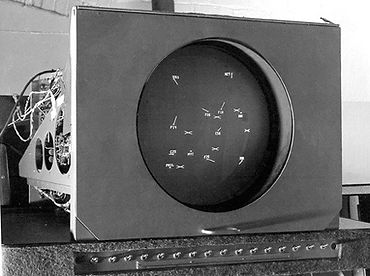
The Massachusetts Institute of Technology (MIT) demonstrated the fastest computer of its time, the Whirlwind. In development since 1945 under direction of Jay Forrester, it was a system intended for use as a “flight simulation environment” (Carlson). It was the very first computer which had the ability to display text and images in real time via an oscilloscopic display (Carlson). The Whirlwind plotted the positional data of aircrafts, transmitted from a nearby radar station, on its oscilloscope in relation to superimposed geographic reference points (Carlson). Switches below the scope allowed operators to view and hide information such as trajectory vectors, identification marks, and tracking numbers (Carlson).
1951


"From left to right: Stephen Dodd, Jay Forrester, Robert Everett, and Ramona Ferenz testing the Whirlwind I in 1951 (Carlson)"
A closer look at the Whirlwind’s Oscilloscope. Note the control switches at the bottom to change displayed information (Carlson).
Whirlwind engineer Robert Everett designed an input device for the Whirlwind that allowed operators to request identifying information about specific aircraft represented on the screen, just by pointing at them (Carlson). This device is called either the light gun or light pen and it works by using a photoelectric cell to measure the light generated by the refreshing of a CRT display (Carlson). The computer tracks what part of the screen is being refreshed, when the light pen detects this change the computer is able to pinpoint the pen’s location (Carlson).
1955
Robert Kirsch creates the first computer scanned image on the Standards Eastern Automatic Computer (SEAC) (“Computer History”). Kirsch designed and used a “rotating drum scanner” to scan a five-by-five centimeter photo of his son, Walden Kirsch (“Computer History”).
1957
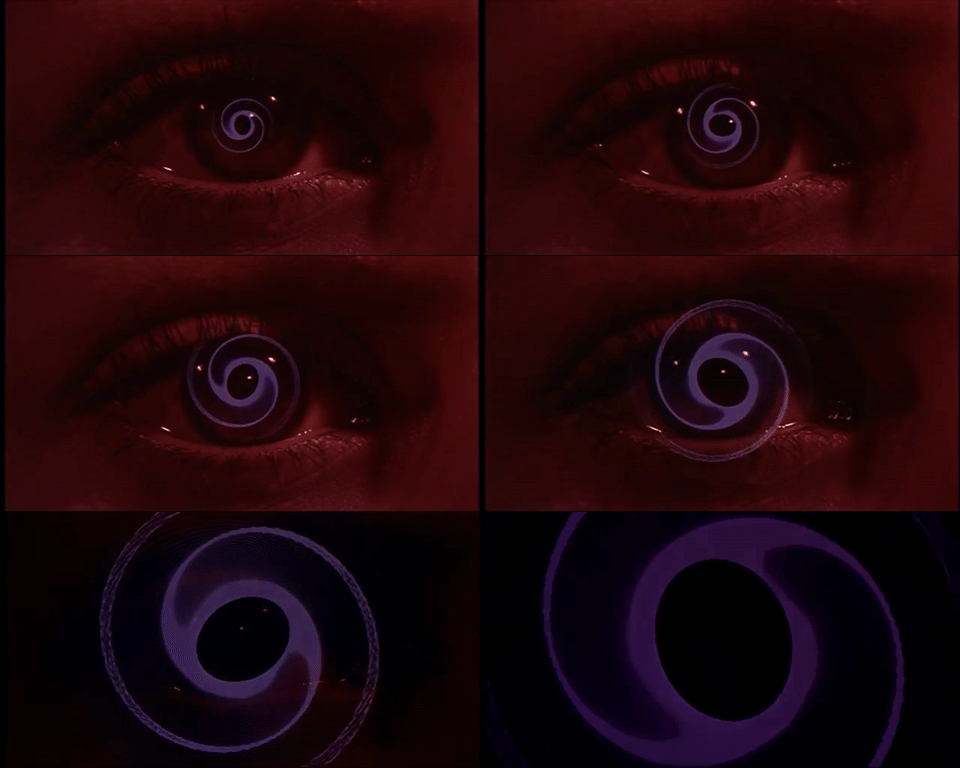
First use of computer aided animation was in the opening credits of Alfred Hitchcock’s “Vertigo” (Carlson). The mastermind behind this sequence is James Whitney who used an analog computer called the M-5 (Carlson). James Whitney and his brother John Witney converted this military anti-aircraft controller for precise camera movements and graphic images (Carlson). James Whitney founded Motion Graphics, Inc. in 1960 which specialized in creating film and television title sequences (Carlson).
1958
The first image ever scanned, a photo of 3-month-old Walden Kirsch (“Computer History”).
William Higinbotham created an electronic game to entertain visitors at Brookhaven National Labs on Long Island, New York called “Tennis-For-Two” (“Computer History”). The game was played on the Donner Model 30, an analog computer with an oscilloscope (“Computer History”). The “ball” used simple physics and even made a sound effect upon contact with the “court” and “racquets” (“Computer History”). Two years after its invention it was scrapped for parts (“Computer History”). Hardly anyone knew of it until Higinbotham testified during the lawsuit between Magnavox and Ralph Baer over the rights to Pong (“Computer History”).
"From left to right: Stephen Dodd, Jay Forrester, Robert Everett, and Ramona Ferenz testing the Whirlwind I in 1951 (Carlson)"
An operator uses a light pen on a SAGE (Semi-Automatic Ground Environment) display, an upgraded CRT display introduced in 1958 (Carlson).
1955
MIT experimented with direct-input keyboards on the Whirlwind (“Computer History”). Up until then, everything had to be fed into the computer as punch cards (“Computer History”). Dog Rob is responsible for coming up with the “electrically-controlled typewriter” design (“Computer History”).
1956

